Welcome to Socotra
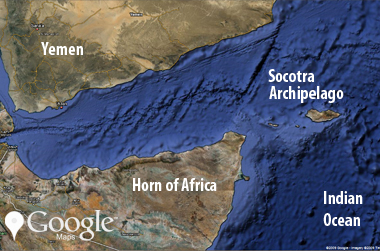
The Socotra Archipelago is a natural gem in the Arabian Sea. It belongs to the Republic of Yemen and is located 380 km from the south Yemeni coastline. Very long isolation from the mainland of Arabian Peninsula and the Horn of Africa has given the islands a precious chance to evolve unique and peculiar species of flora and fauna that cannot be found anywhere else on the Earth.
The number of so called endemics has outreached 300 with more new species discovered each year. This makes Socotra one of the most important sites of biodiversity conservation along such highlights such as the Galapago islands. In 2008, the Archipelago was listed as the Natural World Heritage Site by UNESCO.
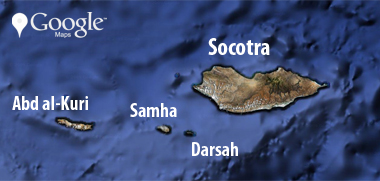
Samha, Abd Al-Kuri and Darsa Islands
The Archipelago consists of four islands with Socotra being the main island covering the area of 3625 km2. The other islands are Abd Al-Kuri (133 km2) and the brothers Samha (41 km2) and Darsa (5.412 km2). There are also two small rocky outcrops called Sabonia and Saiyal.
The other three main islands of the Archipelago are situated to the west of Socotra. The island of Samha is not bigger than 10x5 km with about 100 inhabitants.
Abd Al-Kuri is larger with the area of 25x5 km. About 450 people live on the island.
Both islands are covered with very little vegetation and are extremely isolated. Samha can be reached in about 4 hours by a fishermen’s boat from Qalansiya, Abd Al-Kuri is about 12 hours by a sambok (a big local yacht).
The island of Darsa is not inhabited.
Landscape and Climate
Socotra’s landscape is quite dramatic. The summits of the Haghier Mountains located in the north-western part of the island reach up to 1525 m. Deep gorges contrast with a plateau called Dixam overlooking the Noget Plain along the southern coastline.
The climate of Socotra is determined by the North-East winter monsoon (November – January/February) and the South-West summer monsoon. The dominant summer monsoon takes place from May to September and brings extremely strong, dry and hot winds from Africa. Their speed reaching in average force 7 of the Beaufort Scale makes ship landing impossible and the island remains accessible only by plane during the whole monsoon period. Fishing is also not feasible due to strong winds and high waves and many people move from the coast to the mountains to escape the winds and to harvest their date palms.
The two months period of April to May is the hottest and driest one but with possible rain in some parts of the island. Temperatures usually rise above 40 °C.
The Archipelago
Did you Know
The Socotran Dragon’s Blood tree faces a realistic risk of extinction on the island.