Socotra Zoning Plan
The entire Socotra Archipelago is considered by the Government of Yemen and the Socotris as a special conservation area of high global importance. The people of Socotra have lived in a sound balance with their environment for centuries and until recent days effectively conserved the biodiversity upon which they depend.
The Zoning Plan focuses on the preservation of existing traditional uses and practices of the local Socotri communities to ensure future sustainable use of natural resources. In most cases, traditional practices are highly compatible with the objectives of biodiversity conservation.
Key Zones
The Zoning Plan creates several key zones in Socotra:
Approx. Total Area Covered (terrestrial): 890 km2
Percentage of Total Land Area: 23,5 %
Approx. Total Area Covered (marine): 16.498 km2
Objectives:
To protect and maintain the unique biological diversity of the Socotra Archipelago, as well as other natural, cultural and landscape values of the area in the long term.
To maintain and, if appropriate, contribute to the improvement and strengthening
of existing traditional management practices for the sustainable use of natural resources.
To protect the natural resource base
from being alienated for other land
and resource use purposes that would be detrimental to the unique biological diversity, and to the subsistence of the local community who relies on it.
Percentage of Total Land Area: 23,5 %
Approx. Total Area Covered (marine): 16.498 km2
Objectives:
To protect and maintain the unique biological diversity of the Socotra Archipelago, as well as other natural, cultural and landscape values of the area in the long term.
To maintain and, if appropriate, contribute to the improvement and strengthening
of existing traditional management practices for the sustainable use of natural resources.
To protect the natural resource base
from being alienated for other land
and resource use purposes that would be detrimental to the unique biological diversity, and to the subsistence of the local community who relies on it.
Areas managed to ensure long-term protection of the unique biological diversity of Socotra Archipelago, while providing at the same time, a sustainable flow of natural products and services to meet community needs. Within the Resource Use Reserve, traditional practices are in place, for the sustainable use of natural resources. Such practices are effectively enforced by the community itself, and will be supported by the establishment of the Reserves. These
areas are large enough to absorb natural resource uses without detriment to its overall long-term natural values. For the marine component, all waters within the 12 nautical miles around the archipelago form the Resource Use Zone.
Approx. Total Area Covered (terrestrial): 55 km2
Percent. on Total Land Area: 1.4 %
Percent. on Resource Use Reserve (terrest): 6.14 %
App. Total Area Covered (marine): 1 km2
Objectives:
To allow for the development of essential infrastructure required to improve the standard of living of the local community (i.e. roads, power lines, transportation & health facilities, etc.).
Percent. on Total Land Area: 1.4 %
Percent. on Resource Use Reserve (terrest): 6.14 %
App. Total Area Covered (marine): 1 km2
Objectives:
To allow for the development of essential infrastructure required to improve the standard of living of the local community (i.e. roads, power lines, transportation & health facilities, etc.).
To focus infrastructure & commercial development efforts in roads, power lines, transportation & health facilities, etc.).
To regulate and guide infrastructure and commercial development, so as to minimize environmental damage to neighboring protected areas and natural landscapes as well as to minimize negative impact on natural terrestrial and marine habitats (i.e. compulsory Environmental Impact Assessment, Coastal Zone development guidelines).
Set within the Resource Use Reserve Zone, the General Use Zones include sites where a significant level of habitat modification and/or resource exploitation has already occurred or is required to support essential economic interests of the community of the archipelago.
Marine Zoning Plan Map
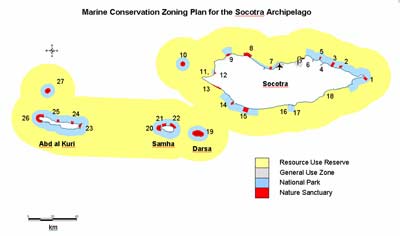
Prepared by Rebecca Klaus on behalf of UNDP-GEF, 1999 ©
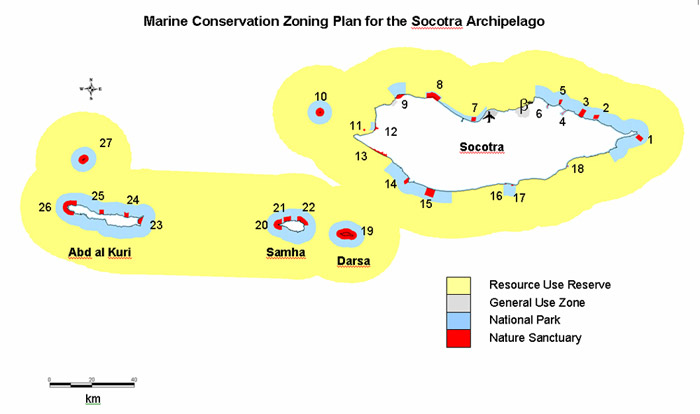
Prepared by Rebecca Klaus on behalf of UNDP-GEF, 1999 ©
Approx. Total Area Covered (terrestrial): 2748,3 km2
Percentage on Total Land Area: 72.6 %
Approx. Total Area Covered (marine): 1514 km2
Objectives:
To protect the unique natural habitats
and landscapes of the Socotra Archipelago that are of high international and national significance for scientific, educational, recreational or ecotourism development purposes.
To support the needs of the local community and subsistence resource users in particular, insofar as this will not adversely affect the objectives
of biodiversity conservation.
To perpetuate, in as natural a state
as possible, representative examples of the unique biotic communities, genetic resources, and species found in the Socotra Archipelago and to provide ecological stability and maintain biodiversity.
To manage visitor use for educational, cultural and recreational purposes at a level that will maintain the area in the current natural or near-natural state.
Percentage on Total Land Area: 72.6 %
Approx. Total Area Covered (marine): 1514 km2
Objectives:
To protect the unique natural habitats
and landscapes of the Socotra Archipelago that are of high international and national significance for scientific, educational, recreational or ecotourism development purposes.
To support the needs of the local community and subsistence resource users in particular, insofar as this will not adversely affect the objectives
of biodiversity conservation.
To perpetuate, in as natural a state
as possible, representative examples of the unique biotic communities, genetic resources, and species found in the Socotra Archipelago and to provide ecological stability and maintain biodiversity.
To manage visitor use for educational, cultural and recreational purposes at a level that will maintain the area in the current natural or near-natural state.
Natural areas of land and sea, designated to: (a) protect the ecological integrity of the unique ecosystems of the Socotra Archipelago for present and future generations; (b) exclude exploitation or occupation inimical to the objectives of conservation of biodiversity and of the preservation of natural landscapes;(c) provide foundation for scientific, educational, recreational, and physical opportunities, all of which must be environmentally and culturally compatible.
Areas of Special Botanical Interest
These areas fall within the National Park Zones and contain the highest concentration of rare and endemic plants of the Archipelago. Special attention is paid to the conservation of this unique heritage by assigning priority to the management and protection of these areas. Other areas of high conservation importance for key zoological groups fall within the boundary of the National Park, and will be mapped in detail later.
Terrestrial Zoning Plan Map
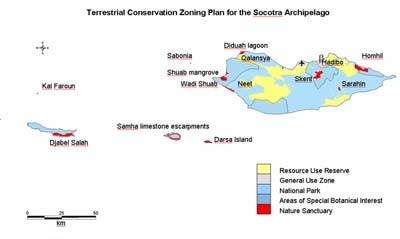
Prepared by Rebecca Klaus on behalf of UNDP-GEF, 1999 ©
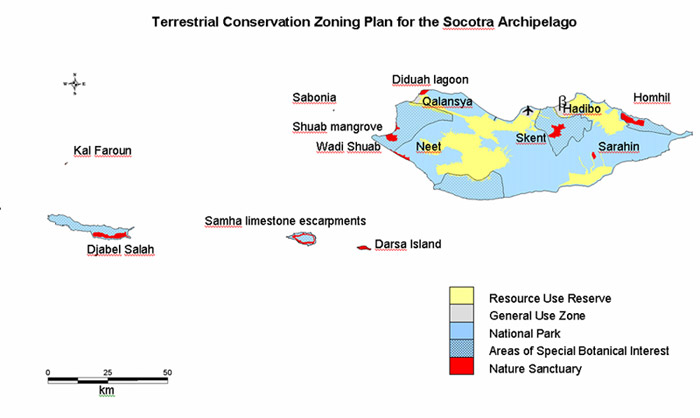
Prepared by Rebecca Klaus on behalf of UNDP-GEF, 1999 ©
Approx. Total Area Covered (terrestrial): 95 km2
Percentage on Total Land Area: 2.5 %
Approx. Total Area Covered (marine): 154 km2
Objectives:
To preserve unique landscapes as well as rare and fragile habitats, ecosystems,
and species in as undisturbed a state
as possible.
To ensure that future generations have the opportunity to experience understanding and enjoyment of areas that have been largely undisturbed by human activity
over long periods of time.
To maintain the essential natural attributes and qualities of the environment over the long term.
To enable the local community living
at low density and in balance with the available resources to maintain their lifestyles.
Percentage on Total Land Area: 2.5 %
Approx. Total Area Covered (marine): 154 km2
Objectives:
To preserve unique landscapes as well as rare and fragile habitats, ecosystems,
and species in as undisturbed a state
as possible.
To ensure that future generations have the opportunity to experience understanding and enjoyment of areas that have been largely undisturbed by human activity
over long periods of time.
To maintain the essential natural attributes and qualities of the environment over the long term.
To enable the local community living
at low density and in balance with the available resources to maintain their lifestyles.
These are areas of unmodified or slightly modified land and sea that retain their natural character and influence without permanent or significant human habitation that will be protected and managed so as to preserve natural or near-natural conditions. These sites are strategically located for the recruitment of plants and animals into other areas through the dispersal of seeds, eggs, and larvae by wind and water. These areas also host important breeding areas.
Nature Sanctuaries are susceptible to degradation by natural events or human activities, and the risk of irreversible environmental damage is high unless the site is strictly protected. Nature Sanctuaries are usually referred to as “Protected Areas”.
The Zoning Plan was prepared on the basis of all previously existing studies on the archipelago and extensive fieldwork as well as data collection carried out on-site by the GEF Socotra Project. This research ran parallel to an extensive consultation process with local communities throughout the archipelago.
Over 60 Yemeni and international experts from a wide range of regional and international institutions joined forces with the project team in what was the largest effort ever performed towards the inventory and mapping of terrestrial and marine biodiversity of the archipelago.
The GEF Socotra Project recruited thirty-four Socotri environmental extension officers from all parts of the archipelago who served as a constant direct link between the Project and the local communities.
An international expert assisted in the development of a draft ecotourism development plan. Areas of high ecotourism potential were identified.
The first draft of the Zoning Plan was used as a basis for extensive consultation with local community leaders in Socotra. A total of 14 large meetings, which involved approximately 500 local sheiks, muqaddams, and local government representatives, were held throughout the islands.
Over 60 Yemeni and international experts from a wide range of regional and international institutions joined forces with the project team in what was the largest effort ever performed towards the inventory and mapping of terrestrial and marine biodiversity of the archipelago.
The GEF Socotra Project recruited thirty-four Socotri environmental extension officers from all parts of the archipelago who served as a constant direct link between the Project and the local communities.
An international expert assisted in the development of a draft ecotourism development plan. Areas of high ecotourism potential were identified.
The first draft of the Zoning Plan was used as a basis for extensive consultation with local community leaders in Socotra. A total of 14 large meetings, which involved approximately 500 local sheiks, muqaddams, and local government representatives, were held throughout the islands.
The UNESCO underlined the importance of protecting the Socotra Archipelago through the establishment of a Man and Biosphere Reserve and placed Socotra at the top of the agenda for declaration (UNESCO, 1994, 2000).
The Global Environment Facility (GEF) and the UNDP assisted the Government of Yemen in the formulation of a comprehensive Biodiversity Conservation Zoning Plan, which represented the essential pre-condition for the declaration of the Socotra Archipelago as a UNESCO Man and Biosphere reserve issued later in 2003.
The Zoning Plan was a pro-active response of the GEF Socotra Biodiversity Project to the opening an airport in Socotra in 1999. The President of the Republic of Yemen, Ali Abdallah Saleh was on board of the first Yemenia Airline Boeing 737 that landed in Socotra.
He immediately announced plans for the construction of a paved road from the airport to Hadibo and Qalansyia and the expansion of the port at Hadibo.
The GEF Socotra Biodiversity Project finalized the Zoning Plan in October 1999. The Government of Yemen approved the Plan in April 2000, by Prime Ministerial Decree, and then ratified the decision by Presidential Decree no. 275 in September 2000. The Plan now represents an important milestone in the history of Socotra. The Socotra Archipelago is the first Protected Area declared in Yemen.
Background of Socotra Conservation Activities
The Government of Yemen ratified the International Convention on Biodiversity in February 1996. In the same year, Government Decree IV declared Socotra as a special natural area in urgent need of protection. The Decree also called for assistance to formulate a Master Plan for Development of the Socotra Archipelago.
In mid-1997, the GEF agreed to fund a project called the "Conservation and Sustainable Use of the Biodiversity of the Socotra Archipelago," that was jointly managed by the EPA and the United Nations Office for Project Services (UNOPS).
The project, which was implemented at the end of 1997, had technical supervision from the UNDP and the GEF. Phase one was completed in 2001 and a second phase with support from the Government of Netherlands was successfully closed in 2003.
In the “Socotra Conservation and Development Programme” (SCDP) in 2003 – 2008, the key stakeholders were UNDP and bilateral donors (Italy and Government of Yemen). SCDP worked closely with EPA, which was meant to gradually take over its activities.
In June 2009, the new Socotra Biodiversity and Governance Project (SBGP) focused on mainstreaming biodiversity management considerations into Socotra’s local governance. Its intended completion has been scheduled for the year of 2013.
Environment Protection
- EPA
- Socotra Governance and Biodiversity Project
- Archive
- Socotra Zoning Plan
- Other Activities On Socotra
Did you Know
An “endemic” species is one that is restricted in distribution. In other words, it can be found in only one place in the world and does not occur anywhere else. Socotra has many endemics.